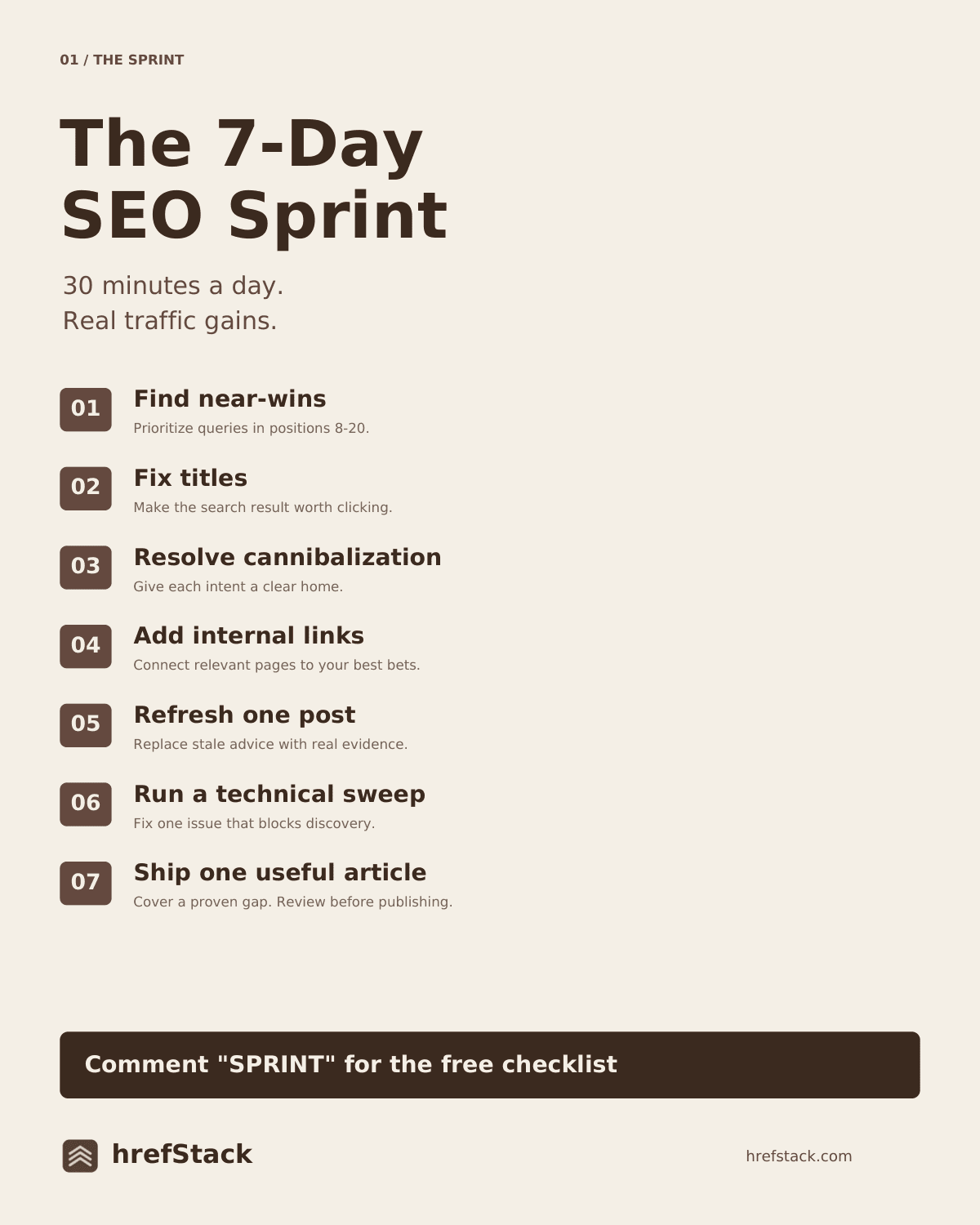
01 / The Sprint
The 7-Day SEO Sprint
30 minutes a day. Real traffic gains.
Built for bootstrapped B2B SaaS founders. Each day is one focused 30-minute session with a clear definition of done. The seven days describe your work schedule, not a promised ranking timeline.
Get the PDF + worksheet
- The full 7-day checklist, print-ready
- Near-win tracker worksheet
- Change log to measure what helped
The working checklist
Make the next session count.
- 01
Find your near-wins
30 minOpen Search Console > Performance > Search results. Select the last 3 months; enable clicks, impressions, CTR and average position.
Use Queries, export the table, and filter average position from 8 to 20. Sort by impressions. Click a query, then Pages, to identify its landing URL.
Choose 10 relevant query/page pairs. Record the baseline; prioritize a small batch of pages you can realistically improve.
Done: A ranked list of 10 query/page pairs. Positions 8-20 are a triage range, not all page-2 results.
- 02
Rewrite titles and descriptions
30 minStart with 2-3 high-impression pages whose CTR is weak relative to similar queries and positions. Under 2% is a review flag, not a universal benchmark.
Write a descriptive title with the main topic early. Aim for roughly 50-60 characters for brevity, not a Google limit. Use a year or number only when useful and accurate.
Write a specific meta description with the benefit and a reason to choose your page. Log the old and new copy.
Done: 2-3 revised search snippets. Review comparable periods after recrawling; a CTR lift is not guaranteed.
- 03
Resolve keyword cannibalization
30 minFor five important queries, inspect the Pages tab in Search Console. Use site:yourdomain.com "topic" as a supplementary discovery check.
Two ranking URLs are not automatically a problem. Check whether they serve the same intent and whether the wrong page is appearing.
Choose: keep distinct intents; reposition one page; or consolidate genuinely overlapping pages. For a merge, preserve useful content, redirect the retired URL to the equivalent page, and update links.
Done: One clear decision per overlap. Plan larger merges now; do not rush them into a 30-minute slot.
- 04
Add useful internal links
30 minChoose the three highest-priority near-win pages. Find established pages with closely related content.
Add up to three relevant contextual links to each target. Write anchor text that describes the destination naturally.
Check that every link resolves to the intended canonical page and helps the reader take a sensible next step.
Done: A source URL, target URL and anchor log. Relevance matters more than hitting a link quota.
- 05
Refresh one aging post
30 minCompare recent clicks with an earlier comparable period. Pick one older post whose information or examples are genuinely stale.
Update a key section with current evidence, a useful screenshot or a first-hand example. Add a short Q&A only if it answers a real reader question.
Show an updated date after substantial revision; retain an accurate original publication date. Clear answers help readers, but do not guarantee AI citations.
Done: One meaningful refresh and a short change log. Never change the date just to look fresh.
- 06
Run a technical sweep
30 minRun PageSpeed Insights on three priority pages. Choose one actionable issue, such as an oversized image; schedule complex script fixes.
In Search Console > Indexing > Pages, inspect a valuable excluded URL. Check indexability, canonical selection, duplication and content usefulness.
Confirm your sitemap contains intended canonical, indexable URLs and was read successfully. "Crawled - currently not indexed" does not need automatic resubmission.
Done: One fix or a ticket with owner and next action. Request indexing only when appropriate after a meaningful change.
- 07
Ship one useful article
30 minReview the Day 1 queries for an intent your current pages do not properly answer. Confirm the gap before creating another URL.
Draft a focused page: direct answer, original example, supporting evidence, useful next step. A deep research article may need more than one session.
Review facts and product claims, add internal links, and record the publication date for later measurement.
Done: One reviewed page, or an approved brief if research needs more time. Check clicks and qualified signups over the following weeks.
hrefStack researches, drafts and publishes this article to your CMS. You review it before it goes live.
Try hrefStack free
Make it actionable
Near-win tracker + change log
Track each query/target URL with its impressions, CTR, position and action, then log every page change with the date shipped and a review date. Compare equivalent periods and watch qualified signups as well as search clicks.
- Query / target URL
- Impressions
- CTR
- Position
- Action
- Date shipped
- Review date
Get the printable worksheet with the full PDF
Your next move
Turn the checklist into a habit.
Review the pages you changed in 2-4 weeks, allowing time for recrawling and enough data. Keep a monthly refresh queue.