03 / The Research Dossier
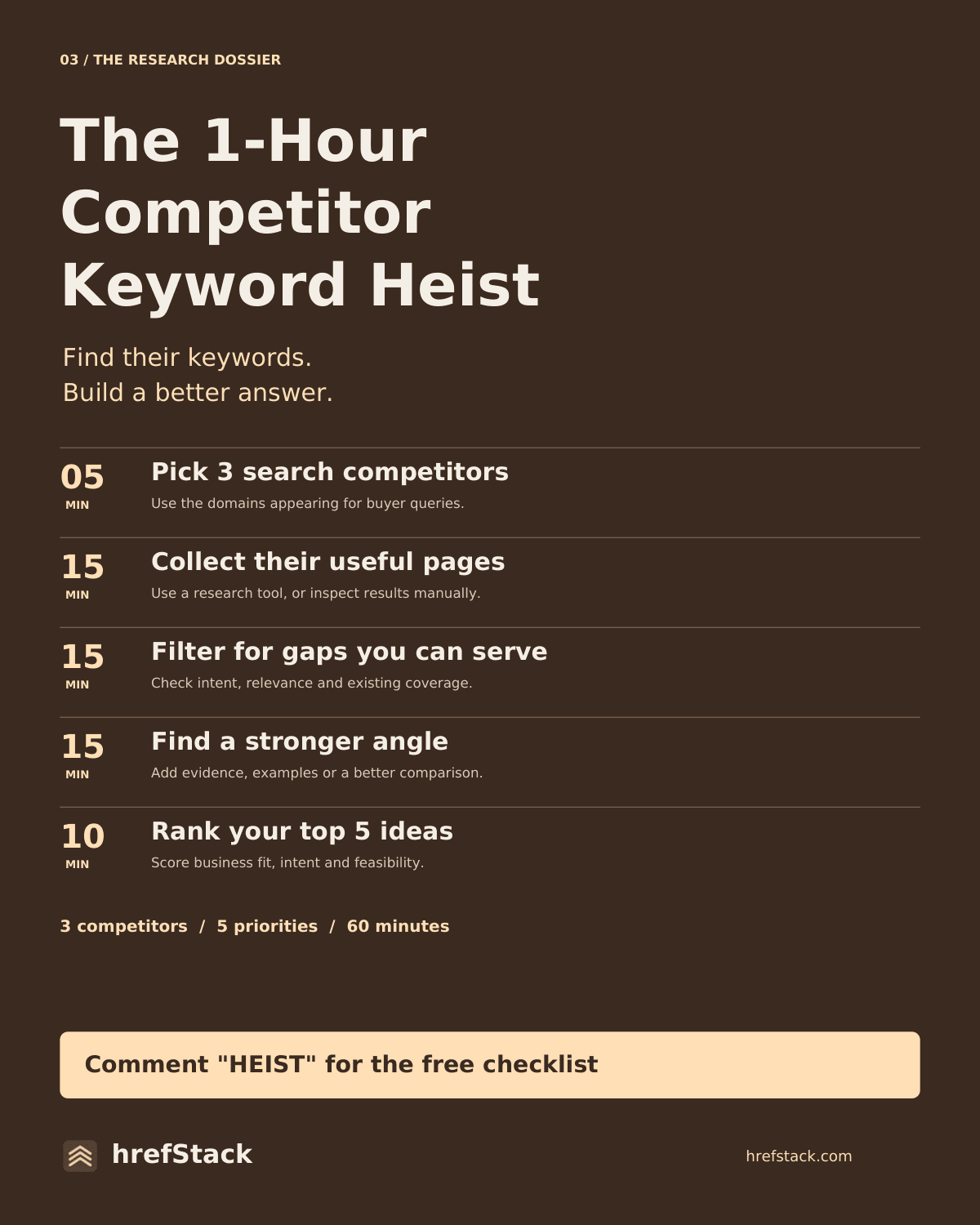
The 1-Hour Competitor Keyword Heist
Find their keywords. Build a better answer.
Built for bootstrapped B2B SaaS founders. 3 competitors, 5 priorities, 60 minutes. The hour creates a shortlist; research, writing and ranking take additional time.
Get the PDF + worksheet
- The full 60-minute checklist, print-ready
- Fit x intent x feasibility scoring worksheet
- Worked scoring example
The working checklist
Make the next session count.
- 01
Pick three search competitors
5 minSearch three important buyer queries in your target market. Record recurring domains and distinguish product competitors from publishers.
Choose three sites with relevant audiences and attainable page opportunities, not just the largest companies in your category.
Record one representative ranking page per domain as a starting point.
Done: Three domains and a clear reason each matters.
- 02
Collect their useful pages
15 minWith competitor-research access, inspect top organic pages in your SEO tool. Record up to 20 relevant pages per domain and the main query for each.
Free plans may restrict competitor reports or exports. Ahrefs Webmaster Tools is for verified sites, not unrestricted competitor top-page analysis.
No paid tool? Manually sample five relevant pages per competitor from search results and their site. You cannot reliably infer traffic or difficulty from that sample.
Done: A source list with URLs, topics and any available estimates. Label estimated traffic; do not treat it as actual analytics.
- 03
Filter for gaps you can serve
15 minKeep topics that connect to your product and a real buyer task. "Best", "vs" and "alternative" can suggest intent; inspect the results to confirm it.
Check your existing pages before calling something a gap. Improve a relevant page instead of creating a competing one.
If you use keyword difficulty, treat under 30 as a tool-specific starting filter. Check who ranks, content quality and your ability to add evidence.
Done: A shortlist of relevant, uncovered intents. Low difficulty does not mean easy rankings.
- 04
Find a stronger angle
15 minRead the leading pages for your best opportunities. Note one concrete omission: a missing use case, weak evidence, unclear trade-offs or outdated steps.
Define the new value you can supply: first-hand screenshots, a worked example, tested criteria or a current comparison.
Draft a five-line brief: reader, intent, direct answer, original proof and next step. Write original copy and verify competitor claims.
Done: A defensible angle for each shortlisted page. A newer date alone is not differentiation.
- 05
Rank your top five ideas
10 minScore business fit, buyer intent and feasibility from 1 to 3 using the worksheet. Multiply the three scores; the maximum is 27.
Use the score to discuss priorities, not to predict traffic. Break ties with stronger evidence or lower production effort.
Choose five topics and assign one next action each.
Done: Five prioritized briefs. Compare qualified leads after publishing; no page format always converts best.
hrefStack turns each brief into a researched draft and publishes it to your CMS. Human review stays part of the workflow.
Try hrefStack free
Make it actionable
Priority scoring sheet
Score = business fit x buyer intent x feasibility, each from 1 (weak / exploratory / hard) to 3 (strong / buying / feasible). A niche comparison with strong fit (3), high intent (3) and moderate feasibility (2) scores 18 / 27. Validate it against the actual search results.
- Topic / target page
- Fit
- Intent
- Ease
- Score
- Distinctive angle
- Owner
- Ship date
Get the printable worksheet with the full PDF
Your next move
Publish one strong page first.
Start with the highest-priority brief. Learn from impressions, engagement and qualified signups before scaling.