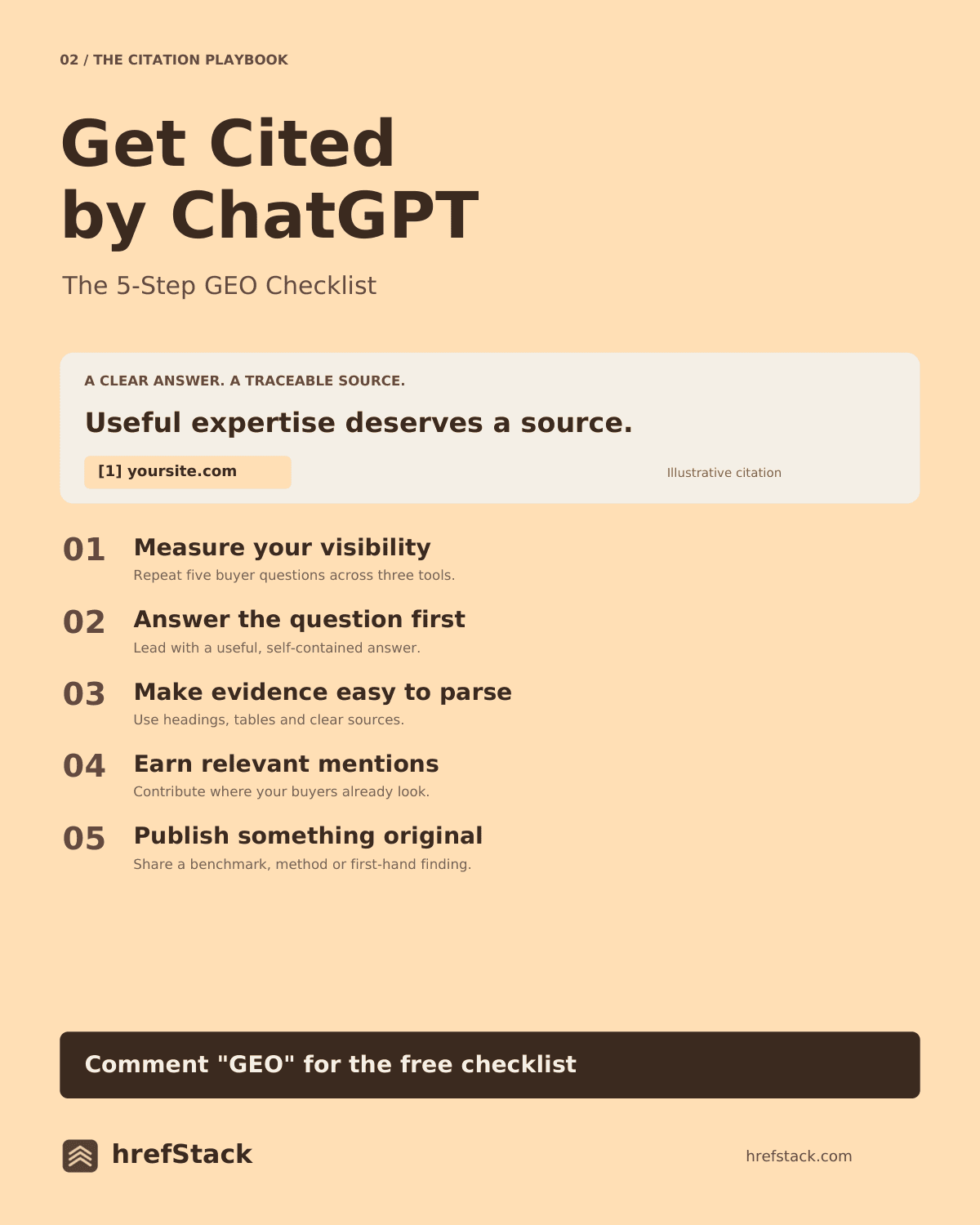
02 / The Citation Playbook
Get Cited by ChatGPT: The 5-Step GEO Checklist
A clear answer. A traceable source.
Built for bootstrapped B2B SaaS founders. Useful expertise deserves a source. These five steps make your pages easier for AI assistants to quote and link, and give you a repeatable way to check whether it is working. Citations vary across tools and sessions; no checklist guarantees inclusion.
Get the PDF + worksheet
- The full 5-step checklist, print-ready
- AI visibility snapshot worksheet
- Mention-rate and citation-rate formulas
The working checklist
Make the next session count.
- 01
Establish a repeatable baseline
15 minWrite five non-branded questions buyers actually ask: a category shortlist, a comparison, an alternative, a workflow and a buying constraint.
Run the same prompts in ChatGPT, Perplexity and Gemini using their web-enabled experiences where available. Keep language, location and mode consistent.
Log the date, prompt, product mentions and exact cited URLs. Repeat the sample later; one response is not a stable visibility score.
Done: 15 observations. Track brand mentions and links to your domain separately.
- 02
Answer the main question first
30 minChoose your three most relevant pages. Replace a vague introduction with a short, direct answer to the page's core question.
Add who the answer applies to, one useful limitation and evidence. Keep the full explanation underneath.
Example: "For a two-person SaaS team, start with pages already earning relevant impressions. Improve those pages before increasing publishing volume."
Done: Three clear introductions. This is a readability tactic, not a citation guarantee.
hrefStack writes answer-first articles with sourced evidence, then publishes them to your CMS for review.
Try hrefStack free - 03
Structure useful evidence
30 minUse descriptive H2s, numbered instructions and comparison tables when they help the reader. Answer genuine follow-up questions.
Keep important facts in accessible page text. Name the author, show accurate dates, and link to the evidence behind specific claims.
Use applicable structured data that matches visible content, such as Article on an article. Do not add FAQ schema as an AI-ranking shortcut.
Done: One page with clear answers and traceable evidence. Google specifies no special schema for its AI features.
- 04
Earn relevant third-party mentions
OngoingChoose communities, review sites and directories that your buyers actually use. Prioritize relevance and editorial standards over volume.
Contribute two useful community answers a week when you have direct experience. Disclose your affiliation and follow promotion rules.
Keep product profiles accurate. Pitch a specific, verifiable reason for inclusion in a relevant comparison; never manufacture reviews or claim independent praise.
Done: A short outreach list and one helpful contribution. Mentions are not guaranteed to produce citations.
- 05
Publish one original finding
Separate projectChoose a small question you can answer with your own experience or responsibly collected data. Define the sample, time period and method.
Publish the finding with context, limitations and a reusable table or figure. Protect customer privacy and avoid unsupported causal claims.
Rerun the baseline prompts periodically. Watch cited URLs, AI referral visits and qualified signups; annotate when you changed a page.
Done: A credible, attributable asset. Initial setup is about 75 minutes; outreach and original research require extra time.
Make it actionable
AI visibility snapshot
For each of five prompts, record the date, language and market, then whether ChatGPT, Perplexity and Gemini mentioned your brand, cited your URL, and which domains they cited. Mention rate = responses naming your brand / valid responses. Citation rate = responses linking your domain / valid responses. A 15-response sample is directional, not a market-share estimate.
- Prompt
- Date / language / market
- Tool / mode
- Brand mentioned?
- Our URL cited?
- Cited domain
Get the printable worksheet with the full PDF
Your next move
Be useful. Be verifiable.
Repeat the same buyer questions regularly. Invest in pages with direct answers, traceable evidence and real expertise.